
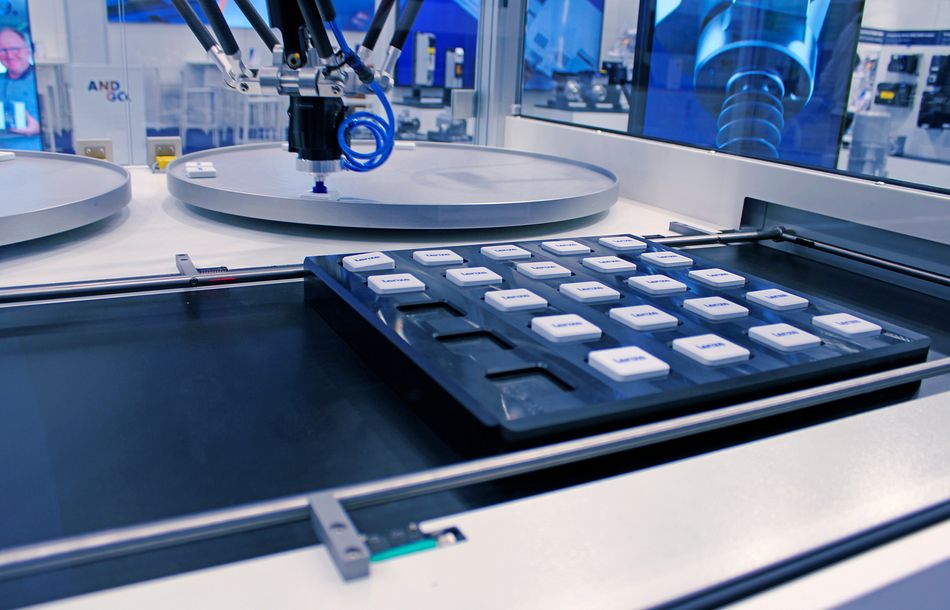
In packaging technology, every stoppage costs valuable throughput. Cycle interruptions during pick-and-place operations are not a technological necessity, they are a design decision. What matters is not only the speed of a robot, but its ability to remain continuously synchronized with the running machine. How this works in practice was demonstrated by Lenze at the Interpack in Düsseldorf with a delta robot.
At the heart of the exhibit wass the interaction of rotary tracking, open interfaces, and the Lenze FAST Robotics Template. Visitors experienced how pick-and-place processes on rotating tables can be realized without stopping the mechanics—efficiently, precisely, and with significantly reduced engineering effort. Machine builders benefit from higher line performance, shorter cycle times, and faster time to market for their applications.
Inline Robotics with rotary tracking
The exhibit featured a delta robot that picks up and places products synchronously from two rotating tables without stopping their motion. This is made possible by rotary tracking—a motion and robotics concept in which the robot computationally “travels along” with the continuous movement of the mechanics. The position, speed, and acceleration of the rotating axes are continuously captured via high-precision servo drives and encoders and processed in real time by the Lenze controller. On this basis, the control system calculates a dynamic target path for the robot, which virtually locks into the rotation and performs the pick-and-place operation during continuous motion. The rotary table does not stop—unnecessary cycle times are eliminated, the mechanics are protected, and throughput is maximized.
Fast commissioning with FAST Robotics
Another key focus is ease of implementation. Instead of traditional, cost-intensive robot programming, Lenze relies on FAST Robotics as part of the Lenze FAST Application Software. This modular software toolkit is based on PLCopen standards and enables seamless integration of robotic kinematics into machine automation. Predefined robot types, ready-made technology modules for pick-and-place applications, and an integrated robotics core significantly reduce engineering effort. Movements are parameterized rather than programmed, extensions can be implemented with minimal risk, and existing applications can be flexibly scaled.
In addition, a digital twin supports virtual commissioning: motion sequences and processes can be tested and optimized even before the physical system is assembled. This reduces project risk, shortens on-site commissioning, and ensures faster time to market. For machine builders, this means less development effort, lower costs, and a robust, future-proof foundation for high-performance robotics applications.
Robotics without system discontinuities
A key characteristic of Lenze inline robotics is its consistent openness. With Lenze FAST Robotics, robotic kinematics can be integrated directly into machine automation—without an additional robot controller, separate programming environment, or extra control cabinet. Motion, logic, and robotics run on a single platform, controlled via a Lenze controller. This reduces system complexity, simplifies engineering, and sustainably lowers costs over the entire machine lifecycle.
Machine builders retain full freedom in system design: alongside integrated robots, both purchased and in-house-developed kinematics can be integrated. Different robot types—from delta and SCARA robots to gantry systems, articulated robots, or palletizing solutions—can be implemented regardless of application or motion guidance. Changes to geometry, product formats, or line concepts can be made at the software level without having to redesign the overall architecture.
The foundation for this is open standards: Lenze consistently relies on PLCopen motion control in its integrated robotics solutions. This ensures manufacturer-independent compatibility, simplifies the expansion of existing machines, and provides investment security—even for future requirements or partner solutions. The result is a future-proof automation platform that enables efficient implementation of complex robotics applications—open to partnerships, flexible in design, and robust in operation.

Source: Lenze