
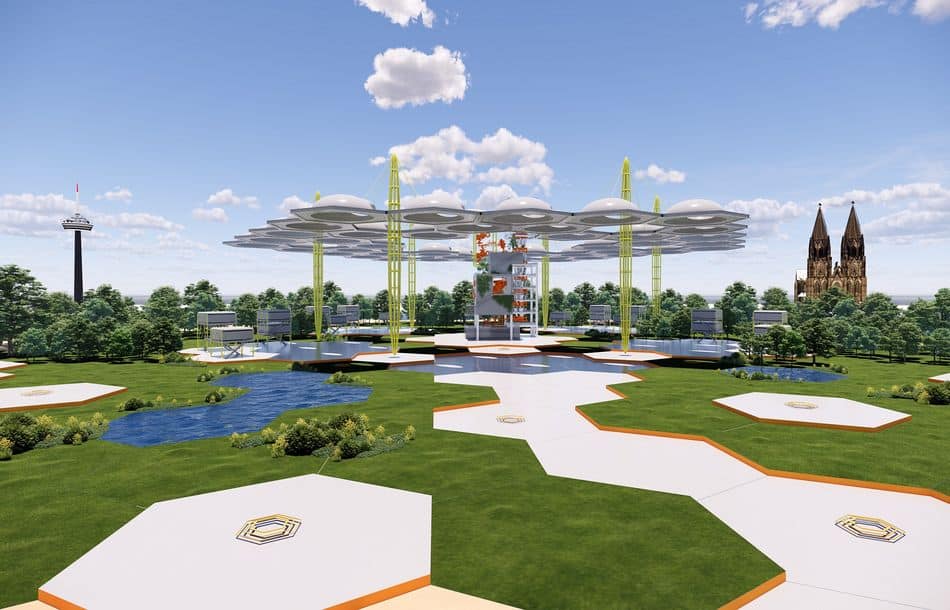
Digitization and innovation are constantly pushing the industry to evolve in new ways. With the creation of the first metaverses, digital spaces and virtual reality have long since solidified their standing among other transformative technologies. Between the lack of spatial limits and the developmental opportunities, the industrial metaverse offers unknown possibilities, with projects like the Iguverse pushing the limits of what a metaverse could be used for.
Travelling through virtual worlds with an avatar, going on adventures with friends, fighting off zombies together: all this is everyday life for Generation Z. In games like Fortnite or Roblox, those born between 1995 and 2010 move quite naturally through the digital parallel universes that science fiction Author Neal Stephenson first described as the metaverse in his 1992 novel “Snow Crash”. But there is much more to it than gaming. Digital space is a technological hot topic. Management consultancy McKinsey estimates that the metaverse could be worth up to $5 trillion by 2030. Technologies such as artificial intelligence, big data, machine learning and 5G will develop sufficient impact to change even industry profoundly. The term used for this phenomenon is “industrial metaverse”. Companies are already using 3D models to map their technology there. When the models are complete, teams from all over the world can work together as avatars across countries and continents in digital space to plan machines, systems and entire factories – faster, safer and more economically than they could in physical reality.
Digital Planning and developmental opportunities
The Siemens Digital Native Factory in Nanjing, China, a manufacturing centre where the company manufactures CNC systems, drives and electric servomotors, shows how the metaverse is changing engineering. At its core is the digital-twin approach. Before building the factory, Siemens simulated the entire infrastructure, including all machines and systems, with a digital twin. This enabled the company to plan building dimensions, material flows and supply of media such as nitrogen, electricity and IT more precisely than ever. The principle is to optimise things in the digital world and then get it right the first time in the real one. The company was able to eliminate planning errors at an early stage – errors that would have cost a great deal of money and time in the past. Digital planning also increased factory productivity by 20%. But that is not all. In the next step, Siemens plans to create digital twins that not only look like real machines, but also behave like them. This means that if technicians simulate a rise in temperature in the environment, for example, they can look at the reactions of the digital twins and draw one-to-one conclusions about reality.
Online sales spaces and experiences with virtual reality
But Siemens is not the only company in Germany to recognise the potential of the industrial metaverse. Igus, the plastics specialist from Cologne that reached the one-billion mark in sales for the first time in 2022, is also experimenting with virtual reality. One aim is to revolutionise sales. For example, customers can put on virtual-reality glasses during consultation appointments and immerse themselves in the iguverse – a virtual space in which all products can be experienced as digital twins. They can admire a 3D model of a minivan in which high-performance igus motion plastics are installed up close. And there is a bicycle made entirely of plastic. Infrastructure such as the 3,800-square-metre laboratory that tests thousands of products at hundreds of stations every year can also be toured. “The iguverse represents a new way of presenting, selling and engineering,” says igus CEO Frank Blase. This new way makes a special impression on people. Blase points out that customers are much more likely to remember experiences from virtual reality than those from conventional sales tools, such as brochures and PowerPoint presentations. Visitors to the IAA Transportation 2022 trade show in Hannover who marvelled at the beginnings of the iguverse at the igus stand confirmed this assessment. “We were in the igus parallel universe for about an hour. Our virtual hands enabled us to make products large and small and view them in detail,” says Dina Reit, CEO at SK Laser, a producer of laser systems based in Wiesbaden-Nordenstadt. Says Blase: “igus is thus taking the first steps towards the metaverse in mechanical and plant engineering, and this has great potential for product presentations.”
Worldwide connectivity: Metaverse innovates digital meetings
However, making products tangible in a new way is only the first stage in the iguverse’s evolution. Igus plans a future in which customers, engineers and material experts from all over the world congregate as avatars in the digital space and implement entire engineering projects there. The process will be faster and smoother than the physical world allows. No travel will be necessary. Nor will there be time-consuming e-mail correspondence or games of telephone tag. Another advantage is that projects will be clearer and more tangible from day one. Engineers will no longer have to exchange abstract data sheets, for instance. Instead, they will be able to create 3D models of machines and systems in the iguverse. Project participants can put on virtual-reality glasses and view the digital twins from all sides. Much like the Siemens Digital Native Factory, this will provide an idea of size and functionality more quickly. And just like Siemens, Igus is planning to use the metaverse not only to engineer machines and systems, but to operate them and provide services as well. It will be an after-sales metaverse, so to speak. In future, machine operators and technicians could meet there for product training. The experience is to be lifelike and therefore much more effective than training videos. Deutsche Bahn is also convinced that it will work. The organisation now uses smart glasses and intelligent software in its training centres. Young technicians can use them to display signal boxes or switches virtually and to interact with digital twins – in a world that is almost as lifelike as reality.
The possibilities of augmented reality
Part of the Igus vision is to merge the virtual iguverse with reality. The bridge technology is augmented reality, with which many are familiar from the Pokémon Go computer game. Here, players view their surroundings through their smartphone camera and hunt virtual fantasy creatures that appear on the screen. Engineers can also benefit from this blend of real and virtual worlds, quickly positioning 3D models from the iguverse in their environment using Igus augmented-reality software. This provides an early impression of whether the real environment can be reconciled with the planned machine. Igus has already developed a similar experiment for sales. An example is triflex-series energy chains. Previously, sales employees hardly had a chance to look inside a closed sample chain. Some mechanical principles were left to imagination. The software now makes it possible to view the product through a smartphone camera. The program overlays the image with a virtual twin in real time. This provides a kind of X-ray view of the mechanism inside the chain. Products that are difficult to explain come to life with augmented reality.
No one knows how fast and in what direction the industrial metaverse will develop. But one thing is certain: it’s not just companies like Siemens and Igus that will determine that development. Users themselves are just as important. A survey by TeamViewer, a software manufacturer, indicates user attitudes. Of a sample of 2,500 people who had heard the term “metaverse”, the majority had no idea what the industrial metaverse was. Almost 70% were unaware of the technology. So there is lots of educating work to be done before the platform experiences a breakthrough, which is why Igus always puts customer utility first. As with all Igus experiments, the question is: do we stick or twist with this new technology?

Source: Igus